Worlds Greatest Stretch Steps and Easier Variations
The world’s greatest stretch is a common name for a mobility sequence combining a long lunge with upper-body rotation and, in some versions, a hamstring-focused shift. It is a descriptive exercise name, not evidence that one stretch is best for everyone.
Use a controlled range. You do not need to place your elbow on the floor or point your raised hand straight overhead to perform a useful version.

Begin with a supported lunge
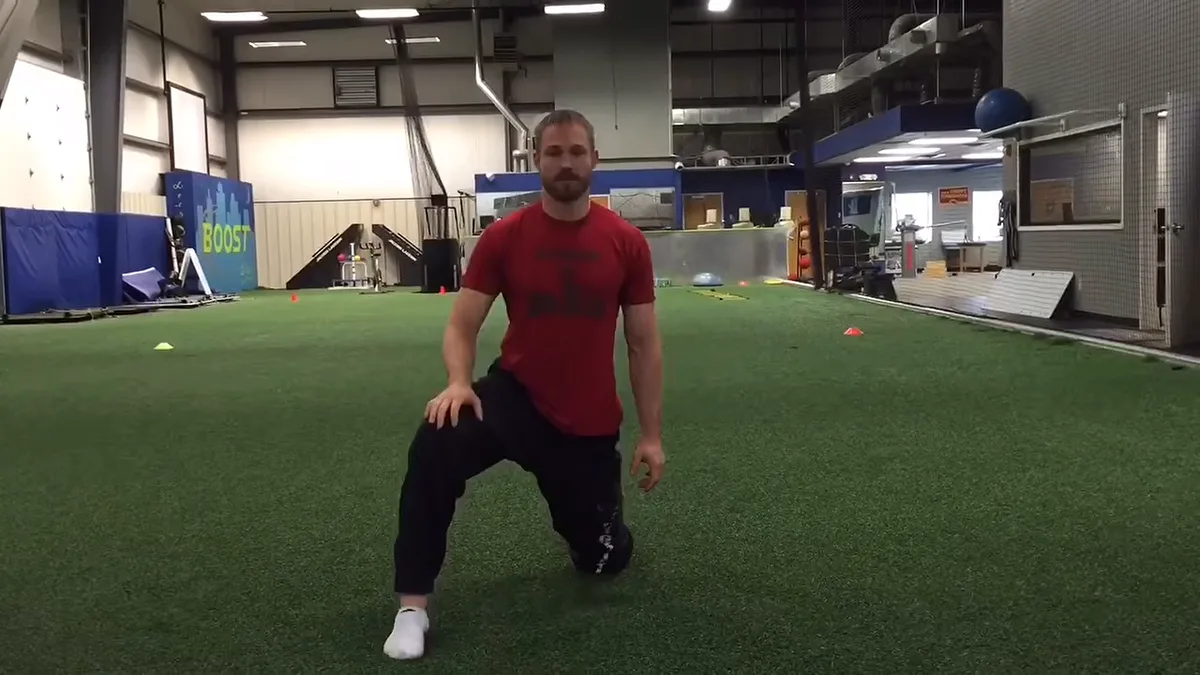
Use a clear, non-slip area. Start in a long lunge with the front foot planted and enough width between your feet to feel stable. Lower the back knee onto suitable padding if that makes the position easier to control.
Place your hands on the floor or stable blocks near the front foot. Blocks should not wobble or slide. If reaching the floor makes your back round or your balance uncertain, raise the support.
Move through the sequence slowly
For this version, imagine the right foot is forward.
- Settle into a comfortable lunge with the right foot planted.
- Keep the left hand supported and bring the right hand or forearm toward the inside of the right leg, only as far as comfortable.
- Return the right hand toward the starting position.
- Rotate the chest toward the right, allowing the right arm to open if comfortable.
- Bring the hand back down and reset your position.
- If appropriate, shift the hips backward slightly for a gentle hamstring-focused variation without forcing the front knee straight.
- Return carefully and switch sides.
These steps describe one common sequence, not a universal standard. Exercise sheets and coaching demonstrations vary in their order and included movements.
Know what you are trying to move
The lunge positions the hips and legs, while the rotation adds movement through the torso. Do not chase a larger arm sweep by twisting sharply through a painful low back or collapsing the front leg inward.
Your eyes can follow the hand if that feels comfortable, but you do not need to strain the neck upward. Keep breathing and pause whenever balance becomes the limiting factor.
The useful range is the range you can control today. Someone else’s flexibility does not define your starting position.
 >
Make the movement easier
| Difficulty | Modification |
|---|---|
| Cannot reach the floor comfortably | Raise the hands on stable blocks |
| Back leg feels hard to control | Lower the back knee with padding |
| Rotation feels restricted | Keep the hand near the chest and rotate less |
| Front knee feels uncomfortable | Reduce depth and reassess the stance |
| Balance is uncertain | Use a more supported variation or another exercise |
If a modification remains painful, choose a different movement and ask for guidance. A mobility exercise should not become a test you must pass at any cost.
Use it as part of a warm up
As a practice example, try two or three slow sequences per side after a little easy movement. This is an editorial starting suggestion, not a validated dose for every person.
Before lifting, running, or sport, continue with movements that match the session. A lunge-and-rotation sequence alone does not prepare every joint and skill you will use. It also does not replace strength training or a personalized rehabilitation plan.
If you prefer a held stretch, avoid forcing the end position. For a dynamic warm-up, move smoothly rather than bouncing or racing through repetitions.
Avoid the common mistakes
Reaching the elbow down by collapsing the whole torso changes the task. A wide arm sweep without controlled torso rotation can also create the appearance of movement without the movement you intended.
Another mistake is using pain as a guide to progress. Stop if symptoms are sharp, radiating, or worsening. People with recent injuries, surgery, or movement restrictions should use individual clinical advice.
New weakness, numbness, or bowel or bladder changes accompanying back symptoms need prompt medical assessment.
Choose the easiest version that lets you move smoothly, then judge it by comfort and control rather than by how close you get to the floor.
Frequently asked questions
Do I need to touch my elbow to the floor
No. That is not a requirement, and forcing it can change your position.
Should my back knee stay lifted
Some versions use a lifted knee; lowering it can make the position more manageable. Use suitable padding and a comfortable setup.
Is this the only warm up I need
No. Add preparation that matches your planned activity and any individual needs.
Why can I rotate farther on one side
There may be several reasons. Do not force symmetry through pain; ask a professional if the difference is new, symptomatic, or concerning.
Can beginners do it
Many can use a supported version. If the combined sequence is difficult, learn the lunge and rotation separately first.