How Often Should You Wash Your Hair
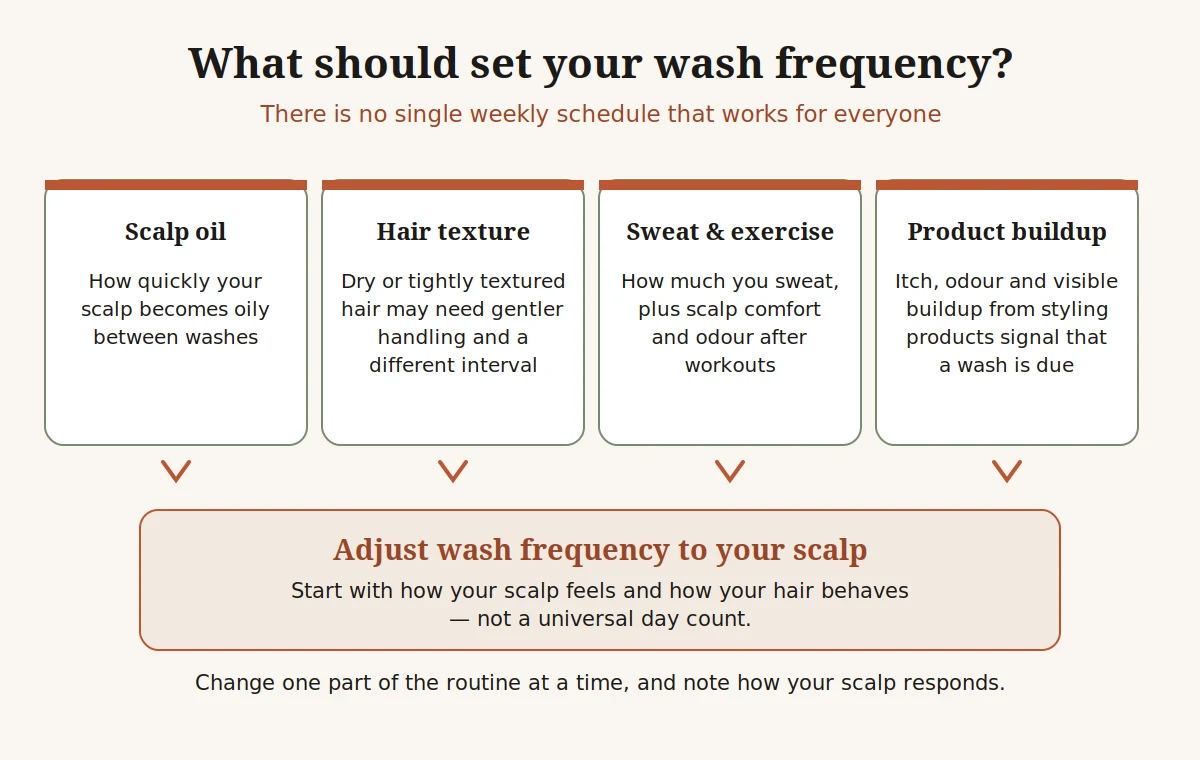
Wash your hair often enough to keep your scalp clean and comfortable while using a routine that suits your hair’s texture and condition. Some people need frequent shampooing; others do well with longer intervals. There is no single weekly schedule that works for everyone.
The most useful starting question is how your scalp feels and how your hair behaves between washes, not how many days an influencer can go without shampoo.
Start with scalp oil and buildup
If your scalp becomes oily quickly, frequent washing may be reasonable. If your hair is dry or tightly textured, the routine may need gentler handling and a different interval. The American Academy of Dermatology recommends washing based on how oily or dirty the hair becomes, with care tailored to hair type.
Notice itch, odor, visible buildup, and how styling products accumulate. Those observations help you adjust the routine, but persistent symptoms should not automatically be blamed on washing too often or too little.
Use these situations to guide the decision
| What you notice | What to consider |
|---|---|
| Roots become oily quickly | A more frequent gentle cleansing routine |
| Lengths feel dry but scalp feels oily | Cleanse the scalp and condition the lengths appropriately |
| Heavy styling-product buildup | Whether your current cleanser and interval remove it |
| Sweat after exercise | Scalp comfort, odor, and product buildup |
| Protective style | A cleansing plan that still reaches the scalp |
| Persistent flakes or irritation | A clinician’s assessment and condition-specific care |
Use the table as a decision aid, not a diagnosis. Hair texture alone does not explain every scalp problem.

Wash the scalp without roughing up the lengths
Apply shampoo mainly where cleansing is needed and use your fingertips gently. Rinse thoroughly. Condition according to your hair’s needs and the product instructions rather than scrubbing the ends repeatedly.
Detangle carefully with a suitable tool. Rough towel rubbing and excessive heat can add damage to a routine that otherwise cleans well. AAD’s guidance emphasizes gentle handling and limiting excessive heat.
If a product leaves your scalp irritated, stop and reassess it. More lather or a strong tingling sensation is not proof of a better wash.
Exercise does not create one automatic rule
Some people want to wash after every sweaty workout; others do not need a full shampoo each time. Consider how much you sweat, the products already present, your scalp’s response, and your hair-care requirements.
Mayo Clinic’s discussion of washing frequency emphasizes factors such as oil production and hair type rather than a universal schedule. If your hair feels fine but the scalp becomes uncomfortable, focus on the scalp problem rather than extending the interval to meet a trend.
Dry shampoo can help appearance temporarily, but it does not perform the same job as washing with cleanser and water. Cleveland Clinic’s guidance also treats washing needs as individual and discusses the limits of relying on dry shampoo.
Why flakes do not always mean dryness
Flakes can have different causes. Adding more oil without knowing the cause may not solve the problem. If you have persistent itching, redness, soreness, thick scale, or unusual shedding, seek professional advice.
If a medicated shampoo is recommended, follow its specific instructions. The frequency and contact time may differ from your ordinary shampoo. Do not replace a prescribed plan with a general beauty schedule.
Change one part of the routine at a time
If your scalp is comfortable, you do not need to change everything because someone says daily washing is always harmful or once-a-month washing is always ideal.
When something is not working, adjust one variable: frequency, cleanser, product quantity, or handling. Keep a short note of what changed and how your scalp responded. Changing several products and the washing interval simultaneously makes it harder to identify the useful adjustment.
Do not force a long interval while enduring itch or buildup in the hope of “training” the scalp. Choose a routine around your observed needs and get help when symptoms persist.
When to get individual advice
See a qualified clinician for ongoing scalp symptoms, sudden or patchy hair loss, pain, or a problem that worsens despite gentle care. A hairstyle or washing schedule cannot explain every change.
Before the appointment, note your products, usual interval, symptoms, and any recent changes. That record is more useful than simply reporting that your routine is clean or dirty.
Frequently asked questions
Is it bad to wash hair every day
Not automatically. It may suit an oily scalp when appropriate products and handling are used. Your scalp and hair response matter.
Should curly hair be washed less often
Many curly or textured routines use longer intervals, but scalp needs still matter. Avoid treating all curls as identical.
Can I use dry shampoo instead of washing
It may change the appearance temporarily, but it does not replace cleansing the scalp.
Does greasy hair mean I am washing too much
Not necessarily. Oil production, products, and individual circumstances all matter. Do not assume one cause from appearance alone.
What if my scalp itches after every wash
Consider the products and technique, and seek advice if the problem persists. Avoid repeatedly adding new treatments without identifying the cause.